
I am Brandon Charles Sandoval Deomampo, I am a Grade 8 student from Mt. KANLAON. I believe in a saying ” Kapag may TIYAGA, may NILAGA”. Which means if you have efforts and you are always doing your best, you can reach what you want.
I am Brandon Charles Sandoval Deomampo, I am a Grade 8 student from Mt. KANLAON. I believe in a saying ” Kapag may TIYAGA, may NILAGA”. Which means if you have efforts and you are always doing your best, you can reach what you want.
Reflection: There are three types of the electricity, one is the voltage, then the current, and the resistance. Electricity needs energy, if there’s no energy, there’s no electricity.
Concepts: The concepts that I learn about this lesson are that a voltage is the change (electron) “pusher”, causes current to flow or move. Sources of voltage are batteries, generators, and outlets. The symbol for voltage is “V”, and the unit for voltage is Volts (V). Next is the current, this is the flow of charge (electrons) within a conductor or how fast charge is moving charge will only flow if there is a voltage source (potential difference). The symbol for current is “I”, and the unit of current is Amps (A) (Amperes). Lastly, resistance opposes the push from the voltage source. This affects the speed of the current. The symbol for resistance is “R”, and the unit for resistance is Ohms (sorry I can’t do the sign of Ohms here✌). Voltage and Current is directly proportional, which means if the voltage is high, the current is also high. In reverese, if the voltage is low, the current is also low. Then in resistance and current, they are inversely proportional. If the resistance is high, the current is low, then in reverese, if the resistance is low, the current is high. There is a formula to find the current. You just need to divide voltage to resistance (I=V/R). Then to find the resistance, you need to divide voltage to current (R=V/I). Lastly, to find the voltage, you need to multiply current to resistance (V=IR). There is also a resistance in a wire. The formula of that is you need to multiply the material of wire and the length dived by area (R=pl/A). The letter “p” means the material of wire, then the “l” means length, and the letter “A” means area. I also learn here that if the resistance of wire is high the area is low, then in reverse if the resistance of wire is low, the area is high. It is inversely proportional. Then in resistance and length, if the resistance of wire is high, the length is also high. Then in reverse, if the resistance of wire is low, the length is also low.
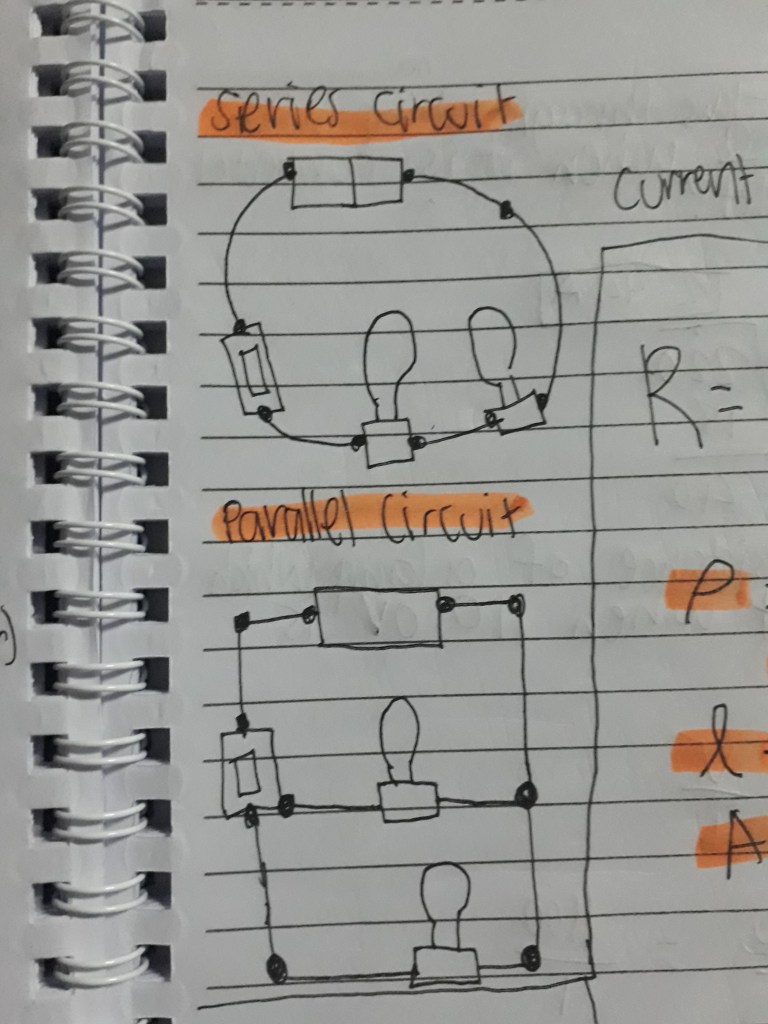
Application in life: In life, there is a Meralco. This is the electricity company of the Philippines. This is very famous in the Philippines. There are news that every week or month, the electricity that we use is becoming higher. That is the bill of your electricity. Example in your house, school, stores, all of the place that has electricity needs to pay in Meralco, if not your electricity will be cut, you have no electricity in your place (naputulan ng kuryente).
Reflection: This is the thermal energy that flows from something of a higher temperature to something of a lower temperature.
Concepts: The concepts that I learn about this lesson are that temperature is the measure of the average kinetic energy of the particles in a sample of matter. Unit of these are Celsius (C) and Fahrenheit Fahrenheit (F). There is also a internal energy and that is the total energy (kinetic and potential) of the particles in a material. To measure the temperature we need to use a thermometer. It is used to measure temperature. When the thermometer is placed in a substance, the heat from that substance may be transferred to the mercury (or alcohol) in the thermometer. There are a temperature units depend of scale. The temperature scales most widely used today are the Fahrenheit, Celsius, and Kelvin scales. There are also a formula to find these scales. If you will change Fahrenheit to Celsius, you need to multiply “C” which is Celsius to 1.8, then add to 32 (F=C(1.8)+32). Then if you will change Celsuis to Fahrenheit, you need to subtract “F” which is Fahrenheit to “32”, then divided by “1.8” (C=(F-32)/1.8). Lastly, if you will change Kelvin to Celsius, you need to add “C” which is Celsius, then add it to “273.15” (K= C+273.15). I also learn about the Thermal Equibilirium, this is the state in which two bodies in physical contact with each other have identical temperatures. This is the basis for measuring temperature with thermometers in that the thermometer must be in thermal equilibrium with an object before a temperature reading can be taken. State of matter is also related to the temperature. These are solids, liquids, and gases. States of matter are determined by the rate at which atoms or molecules move. The first one are solids, these are tightly packed with fixed volume and shape. Then liquids are hot as tightly linked with fixed volume, but no shape. Lastly are gases, these are particles with little or no attraction, no fixed volume or shape. I also learn about the meaning of Thermal Expansion. These are the temperature of a gas at constant pressure causes the volume of the gas to increase. Also occurs in solids and liquids. Then Specific Heat Capacity is defined as the energy required to change the temperature of 1 kg of a substance by 1 degrees Celsius. Then the Specific Heat of Water are relatively high specific heat capacity of water means that it resists changes in temperature. There is also a formula to find the heat. If you will multiply the mass, the specific heat capacity, and the change in temperature, you will find the heat (Q= mc🔺T), “Q” stands for heat, “m” stands for mass, “c” stands for specific heat capacity, and “🔺T” stands for change in temperature. Lastly, if you release heat the heat capacity will be negative, then if you will absorb heat, the heat capacity is positive.
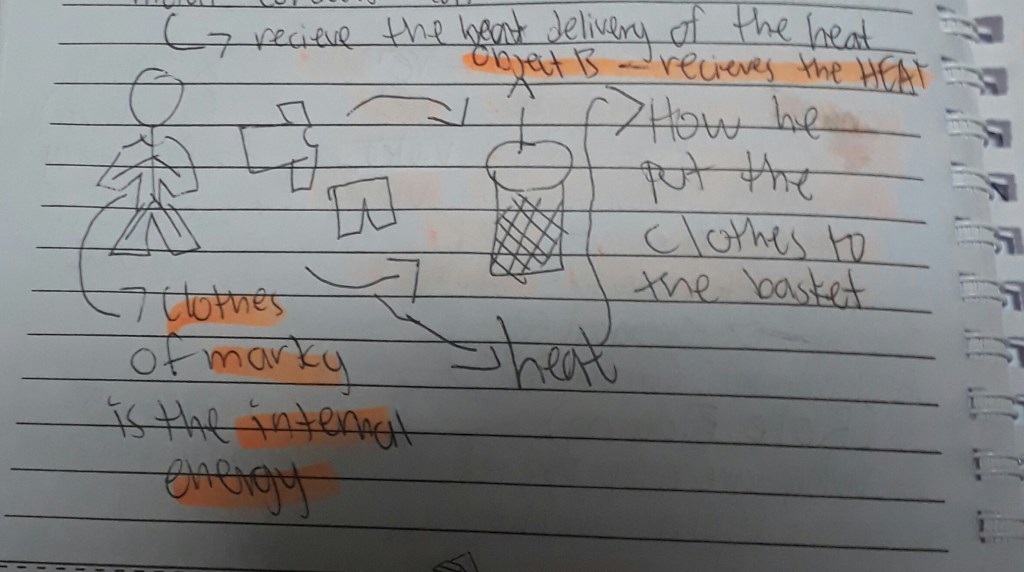
Application in life: 1 example of heat and internal energy is if I am wearing a clothes, those are the internal energy, and if I take it off, then put it in the laundry, therefore I am applying heat. This is because the laundry basket receives the heat, then how I put the clothes to the laundry basket, it also have heat.
Reflection: This is produced by vibrations, there is a disturbance in the medium through longitudinal. This is a wave that is parallel on it’s displacement . If there’s no medium, there’s no sound.
Concepts: The concepts that I learn in this lesson are that a sound needs media to transmit. The speed of sound does not depend on the source, but on the medium. The speed of sound is 30 m/s. Sound travels on a wave. Longitudinal wave is the wave in sound. This is because the wave is parallel to the direction of the wave length. I also know that sound travels through air, the particles vibrate parallel to the direction of wave propagation. The inetensity of a wave id proportional to the square of the amplitude. Intensity is measured objectively through instruments oscilloscope. Then a loundness is the physiological sensation of the brain. It is related to sound intensity. I also learn that if the higher the amplitude of the sound wave, the louder the sound. Then, pitch is the subjective impression about the frequency of the sound. Higher the frequency, more vibrations, therefore higher the pitch, higher the frequency.
Application in life: Example of this when we have a lab activity, then our teacher in Science played a dope and cool songs, that have a high tune or beat. Then he put some rock salt in tha speaker. When the songs are played, all of the rock salt bounced. This is because of the beat and sound of the song. It has a high pitch.
Reflection: This is the only thing we can see (visible light). This is an energy emitted by accelerating electric charges often electrons. It is also doesn’t need a medium to travel.
Concepts: The concepts that I learn about this lesson are that a light travels in a wave form that is called Electromagnetic wave. I also discover about the light colors. Like the violet light has the shortest wave length. The violet light has measure of 400 nanometer. While the red has a large wave lenght. The red measures of 700 nanometer. Actually it is estimated. The real measure of the violet light is 410 nanometers, while the red light has a 680 nanometers. The colors in the visible light have different wave frequencies and wave length. I also know that the white light is the present of colors, while the black is the abscence of colors. Dispersion occurs when white light passes through a prism. Refraction is the bending of light when it travels from one medium to another pf different optical densities. Density is the compact of the molecules. There’s a formula to find the density. It is P= mass/volume.. When light travels in another medium, refraction occurs. There is a “smooth reflection” and a rough reflection”. Smooth reflection is when a light passes to a mirror, the light bounce back to another direction. It has only have a one direction. While a rough reflection is when a light passes to a mirror it bounce back too, but if the glass is blured or what, the light bounce back in different direction. The speed of light in a medium is 300, 000, 000 m/s. There is also a Physical Density it refers to the mass/ volume ratio. Then, Optical Density sluggish tendency of the atoms of a material to maintain the absorbed energy of an electromagnetic wave in the form of vibrating electrons before reemitting id as a new electromagnetic disturbance. The more optically dense that a material is, the slower that a wave will move through the material. The higher the optical density, the lower the speed of light, then the lower the optical, the higher the speed of light. It is indirectly proportional. I also learn about the index of refraction is the index of refraction value of the material. The formula of this is n= speed of light in vacuum, which is 300, 000, 000 m/s / the speed of light in a medium, which is 150, 000, 000 m/s. We need to remember this, if the optical density is high, the index of refraction is also high, then if the optical density is low, the index of refraction is low too. It is directly proportional. Then in speed of light in a medium and the optical density, it is directly proportional. If the optical density is high, the speed of light in a medium is low. Then if the optical density is low, the speed of light in a medium is high. It is indirectly proportional. I also learn that the shortest wave length is the violet, then the longest is the red. Theb in frequency, the lowest is the red, and the highest is the violet. Lastlt in energy, the lowest is the red, and the highest is the violet, so it means that the violet is the hottest visible light that we see.
Note: If the wave speed and the wave length change as light travels to another medium, but its frequency does not change. All of the light colors is same of speed at the vacuum, but in medium, the wave length and wave speed change. If the wave speed is high, the wave length is high too, and if the wave speed is low, the wave length is low too. It is directly proportional.
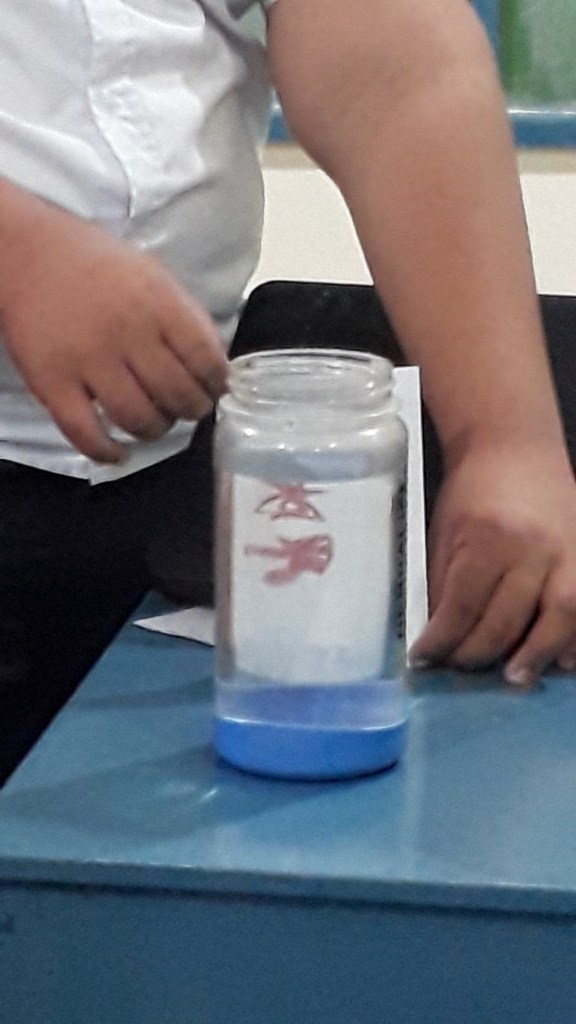
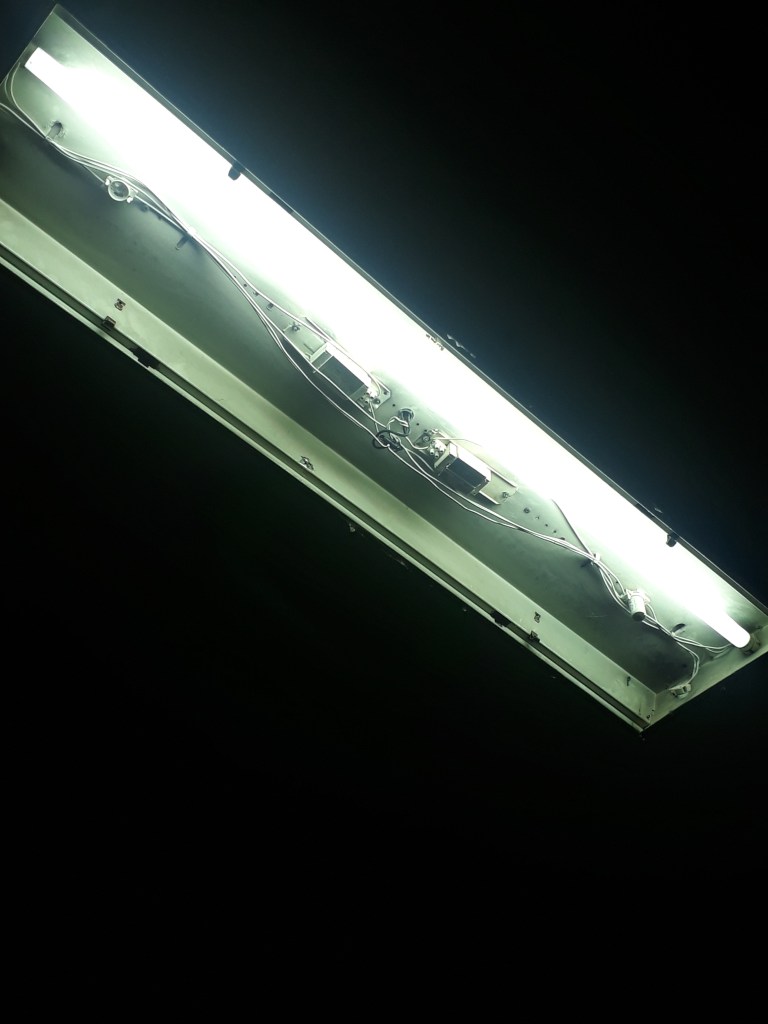
Application in life: When there’s a light bulb and electricity it is having a light.
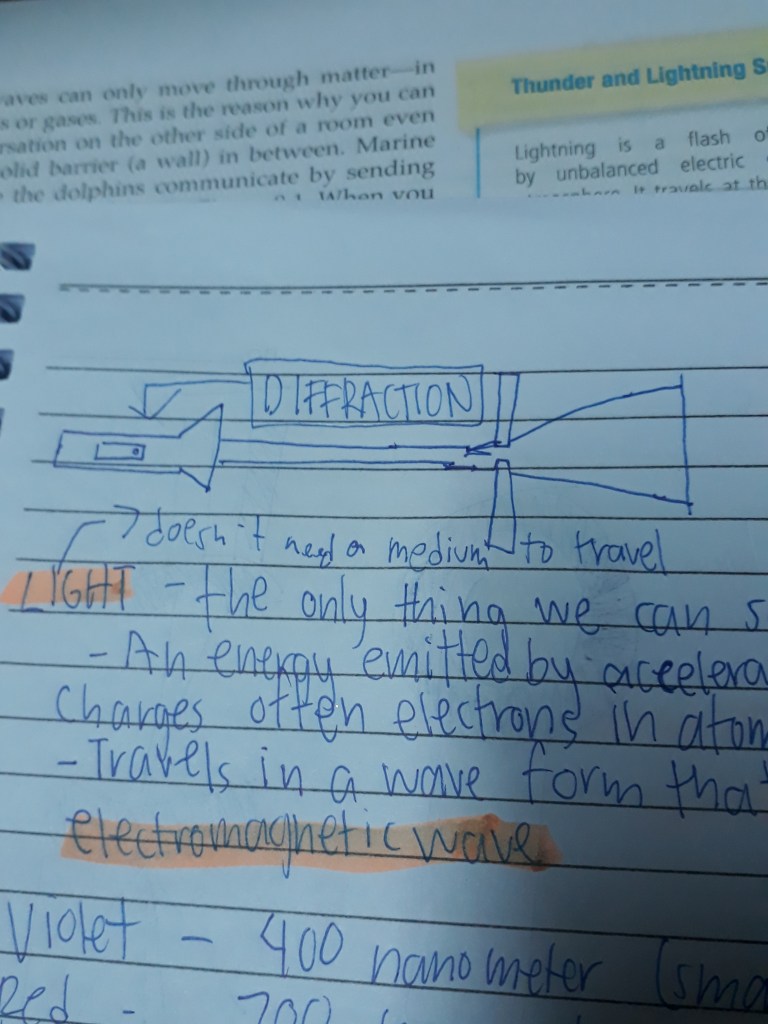
Last example if you have a flash light then you are using it, it has light. It is traveling in a one direction, but if you blocked it by a object or a thing and it has a small hole, it will be seperated or scattered, it will have different direction. It is callled Diffraction.
Reflection: Energy is the ability to cause change. There are three types of energy, one is the Kinetic energy, the Potential energy, and the Mechanical energy. Kinetic energy is the energy of an object has due to its motion. If an object isn’t moving, it doesn’t have this energy. While the Potential energy is the energy stored in an object because of its position. It has the “potential” to cause change. Lastly in a Mechanical energy this is the sum of Potential and Kinetic energy.
Concepts: The concepts that I learned about Kinetic energy is the higher the mass, the higher the kinetic energy. Kinetic energy is the energy of motion. Also if this energy increases the object moves faster. Lastly, Kinetic energy increases as the mass of an object increases. There is a formula to find the Kinetic energy. To find this, you need to multiply one half to the mass and velocity squared (KE= 1/2mv2). Then to find the mass you need to multiply two and Kinetic energy divided by velocity squared (m= 2KE/v2). Lastly to find the velocity, you need to multiply two and Kinetic energy, divided by mass, then find the square root. (V2KE/m) Secondly, the concepts that I learned about Potential energy is that the more mass an object has, the more potential energy. Potential energy is stored energy. It is greater if the position of an object is higher. It is also increases as the mass of an object increases. The unit of this is joules. There is also a formula to find the Potential energy. To find the Potential energy, you need to multiply mass, acceleration due to gravity, and height (PE=mgh). You can apply the “magic triangle” here. Joules is also the unit of this energy. Finally, the thing that I learn about Mechanical energy is an energy in an object that is used to do work. In other words, it is an energy in an object due to its position or motion, or both.
Application in life: In Kinetic energy, if I shoot a basketball into the ring, then I am on the perimeter line, I need a lesser force. This is because I’m neerer by the ring. Then if I shoot on the three point line, I need a higher force. This is because I am further by the ring. I’m applying Kinetic force. This is because I am applying different forces to the ball, so that it can have motion. Then in Potential energy, if I am using a archer then I’m pulling back the string I am applying Potential force, because I am depending on my position or configuration of my body and my surroundings. It is also possesses elastic potential force. We all know that Potential energy is a stored energy. Lastly, in Mechanical force, if I am putting a wooden bed on a wall by using a hammer and a nail, I can do that by using and applying greater energy to the hammer to push the nail on a wooden part of the bed, so that it can stick on the wall, I am applying Mechanical force. This is because I’m applying greater energy to the hammer, so that the position of this object is higher and the nail can stick to the wooden bed on the wall. Off course, it is not just have a one nail, it has some nails to stick. If it has only one nail it can’t stick or hang on the wall, because there’s not enough nail on the wooden bed. Now, I have a cool bed, because I have a bed that it is hanging on the wall. It’s like a plane that is flying. The lesson here, if you apply greater energy, the higher the object is.
Reflection: Work needs force and displacement. The force should be parallel with respect to displacement. There’s three conditions of work. First there must be a force acting on the object. Then, the object has to move a certain distance called the displacement. Lastly, there must be a component of the force in the direction of the motion.
Power is the rate doing work. This is measured in joules per second (J/s) or watts (W).
Concepts: The concepts that I learn in these lessons are whenever you do something, you are applying work and power. There is always a work and power in every movement that we do. To find the formula of work, you need to multiply force to displacement (W= Fd). Then to find the force, you need to divide work to displacement (F=W/d). Lastly, to find the displacement, you need to divide work to force (d=W/F). You can easily remember all of these by using the “magic triangle”. Nextly to find the formula of power, you need to divide work to time (P=W/t).
Application in life: If I am pushing a cart from rest, I am applying work. This is because I apply force to the cart, so that the cart can move, but if I didn’t apply force to the cart, the cart stays at rest. There’s no motion. Then in power, if my brother and I are running and racing to each other until at the finish line, we are applying power. This is because we are applying strength to reach the finish line. We are releasing speed, so that we know who is faster.
Reflection: This is defined as motion in a circle at a constant speed. There’s two types of circular motion, one is the Centripetal force and the Centrifugal force. Centripetal force is pulling the object towards the center of the circular path (inward), while a Centrifugal force is an outward movement of your body due to a force effect which is attributed not to any real force but to inertia (outward).
Concepts: The concepts that I learn in this lesson are there’s a formulas in solving the circular motion. To find the Centripetal force you need to multiply the mass and velocity squared, then divide it by radius (Fc=mv2/r). Then, to find the radius you need to multiply the mass and velocity squared, then divide by Centripetal force (r=mv2/Fc). Then, to find the mass you need to multiply the Centripetal force and radius, divided by velocity squared (m=Fc.r/v2). Lastly to find the velocity you need to multiply the Centripetal force and radius, divided by mass, then find the square root. ( v= VFc.r/m).
Application in life: If I am riding a racing car that is travelling around a circular racing track, I am applying Circular motion, because I am just travelling around a circle racing track and I have constant speed. I am not changing of speed. If my constant speed is 1 km/s, that means that every point of the circular racing track, my car would be moving at 1 km/s.
Reflection: This lesson is about exerting force to another force. One force is called the action force and the other force is called the reaction force. Neither force can exists without the other.
Concepts: The concepts that I learned in this lesson are Whenever one object exerts a force on a second object, the second object exerts an equal but opposite force on the first object. Example, if object A exerts a force on object B it is applying action reaction, then in reverse if object B exerts a force on object A it is also applying action reaction, because object A and object B applies force in each other equally and oppositely. Example of this is if I give a high five to my friend I give him/her a force, he/she also give me a force, then it is equally and oppositely. I am the action, and my friend is the reaction. There is also a example that it has “no motion”. This is possible if there’s another person, then you are applying same amount of force in an object, there’s no motion applied.
Application in life: If I am shooting or realising a basketball, I am applying the action reaction, because I am pushing the ball upward, then the ball equally and oppositely pushed me too.
Reflection: This lesson is about Force, Mass, Acceleration, Distance, Speed, and Displacement. It is more on solving problems. It has formulas to solve some mathematical problems. Also the force is directly proportional to mass and to acceleration, then mass is inversely proportional to acceleration.
Concepts: The concepts that I learned in this lesson are if you apply higher force, it also have a higher acceleration. Then if a you apply lower force, the lower the acceleration. In force and mass, if you apply higher force, it has higher mass too. Then if you apply lower force, it has also lower mass. It is also the same in force and acceleration. Lastly, in mass and acceleration, if the mass is higher, the lower is the acceleration. Then in inversely proportional, if the mass is lower, the higher the acceleration.
There are formulas here, examples: If you will find the net force you will multiply the mass to the acceleration (Fnet=ma). Another example, if you will find the acceleration you will divide the net force to the mass (a=Fnet/m). Lastly, to get the formula of the mass you will divide net force to the acceleration (m=Fnet/a)
Application in life: If I am running I am applying acceleration, because I am speeding up. Also if I am riding my bike, then I pull the brake, I also applying acceleration, because I am slowing down. Lastly, if I have a jetpack, then I am flying around in the sky, I am applying acceleration, because I am changing direction.
Reflection: If an object at rest, stays at rest and an object in motion, stays at motion, unless there is an external force applied.
External force: are forces caused by external agent outside of the system.
The concepts that I learned in this lesson are when we have an experiment about egg drop and peso bill. In the Egg drop, if there’s higher force you apply to the pan, there’s a chance that the egg will fall inside. Also if you hit the pan “horizontally” the egg will fell inside the cup. Then in the peso bill, higher force coins will stay. Then less mass of the coin, the coin will stay. And lastly if there’s less force in the peso bill, there’s a tendency for the coins to move.
Applications in life: If a ball is rolling down a hill it will continue to roll unless there is friction or an external force to stop it.

 brandonbl0gz