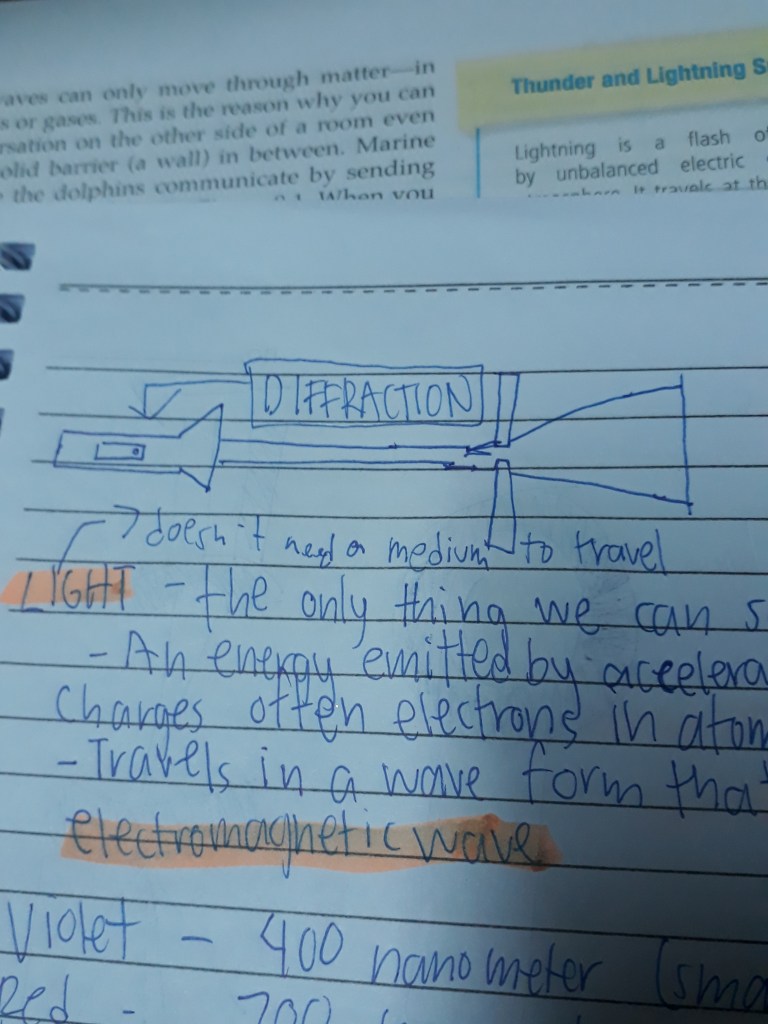
Reflection: This is the only thing we can see (visible light). This is an energy emitted by accelerating electric charges often electrons. It is also doesn’t need a medium to travel.
Concepts: The concepts that I learn about this lesson are that a light travels in a wave form that is called Electromagnetic wave. I also discover about the light colors. Like the violet light has the shortest wave length. The violet light has measure of 400 nanometer. While the red has a large wave lenght. The red measures of 700 nanometer. Actually it is estimated. The real measure of the violet light is 410 nanometers, while the red light has a 680 nanometers. The colors in the visible light have different wave frequencies and wave length. I also know that the white light is the present of colors, while the black is the abscence of colors. Dispersion occurs when white light passes through a prism. Refraction is the bending of light when it travels from one medium to another pf different optical densities. Density is the compact of the molecules. There’s a formula to find the density. It is P= mass/volume.. When light travels in another medium, refraction occurs. There is a “smooth reflection” and a rough reflection”. Smooth reflection is when a light passes to a mirror, the light bounce back to another direction. It has only have a one direction. While a rough reflection is when a light passes to a mirror it bounce back too, but if the glass is blured or what, the light bounce back in different direction. The speed of light in a medium is 300, 000, 000 m/s. There is also a Physical Density it refers to the mass/ volume ratio. Then, Optical Density sluggish tendency of the atoms of a material to maintain the absorbed energy of an electromagnetic wave in the form of vibrating electrons before reemitting id as a new electromagnetic disturbance. The more optically dense that a material is, the slower that a wave will move through the material. The higher the optical density, the lower the speed of light, then the lower the optical, the higher the speed of light. It is indirectly proportional. I also learn about the index of refraction is the index of refraction value of the material. The formula of this is n= speed of light in vacuum, which is 300, 000, 000 m/s / the speed of light in a medium, which is 150, 000, 000 m/s. We need to remember this, if the optical density is high, the index of refraction is also high, then if the optical density is low, the index of refraction is low too. It is directly proportional. Then in speed of light in a medium and the optical density, it is directly proportional. If the optical density is high, the speed of light in a medium is low. Then if the optical density is low, the speed of light in a medium is high. It is indirectly proportional. I also learn that the shortest wave length is the violet, then the longest is the red. Theb in frequency, the lowest is the red, and the highest is the violet. Lastlt in energy, the lowest is the red, and the highest is the violet, so it means that the violet is the hottest visible light that we see.
Note: If the wave speed and the wave length change as light travels to another medium, but its frequency does not change. All of the light colors is same of speed at the vacuum, but in medium, the wave length and wave speed change. If the wave speed is high, the wave length is high too, and if the wave speed is low, the wave length is low too. It is directly proportional.
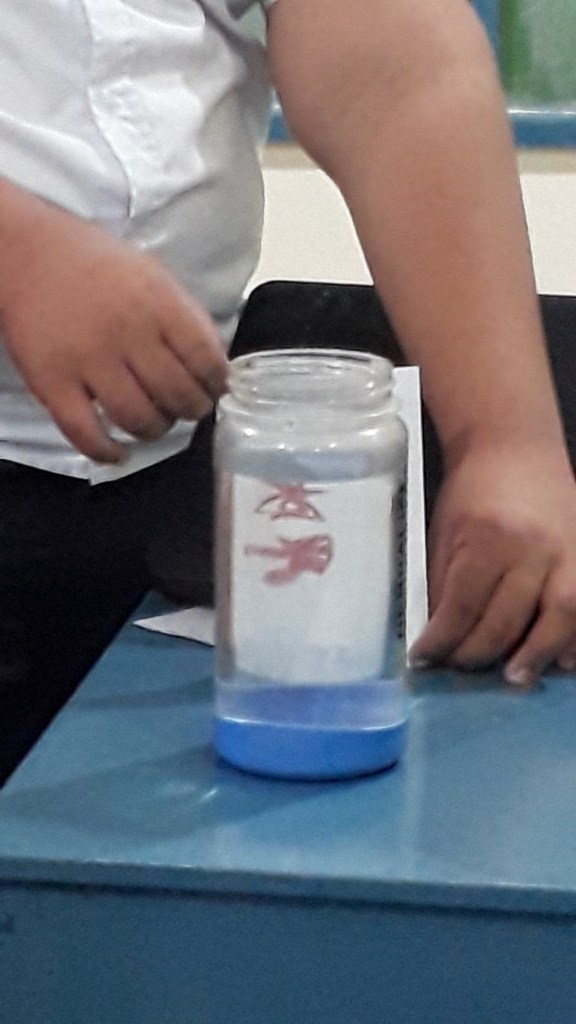
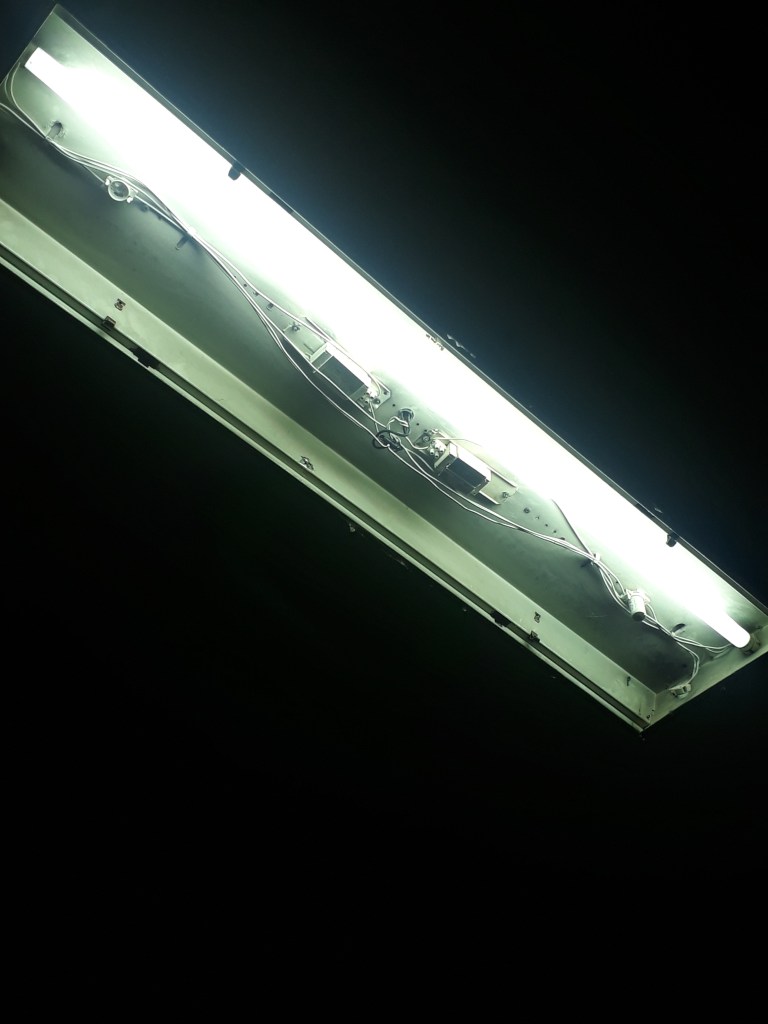
Application in life: When there’s a light bulb and electricity it is having a light.
Last example if you have a flash light then you are using it, it has light. It is traveling in a one direction, but if you blocked it by a object or a thing and it has a small hole, it will be seperated or scattered, it will have different direction. It is callled Diffraction.
 brandonbl0gz