Reflection: This is the thermal energy that flows from something of a higher temperature to something of a lower temperature.
Concepts: The concepts that I learn about this lesson are that temperature is the measure of the average kinetic energy of the particles in a sample of matter. Unit of these are Celsius (C) and Fahrenheit Fahrenheit (F). There is also a internal energy and that is the total energy (kinetic and potential) of the particles in a material. To measure the temperature we need to use a thermometer. It is used to measure temperature. When the thermometer is placed in a substance, the heat from that substance may be transferred to the mercury (or alcohol) in the thermometer. There are a temperature units depend of scale. The temperature scales most widely used today are the Fahrenheit, Celsius, and Kelvin scales. There are also a formula to find these scales. If you will change Fahrenheit to Celsius, you need to multiply “C” which is Celsius to 1.8, then add to 32 (F=C(1.8)+32). Then if you will change Celsuis to Fahrenheit, you need to subtract “F” which is Fahrenheit to “32”, then divided by “1.8” (C=(F-32)/1.8). Lastly, if you will change Kelvin to Celsius, you need to add “C” which is Celsius, then add it to “273.15” (K= C+273.15). I also learn about the Thermal Equibilirium, this is the state in which two bodies in physical contact with each other have identical temperatures. This is the basis for measuring temperature with thermometers in that the thermometer must be in thermal equilibrium with an object before a temperature reading can be taken. State of matter is also related to the temperature. These are solids, liquids, and gases. States of matter are determined by the rate at which atoms or molecules move. The first one are solids, these are tightly packed with fixed volume and shape. Then liquids are hot as tightly linked with fixed volume, but no shape. Lastly are gases, these are particles with little or no attraction, no fixed volume or shape. I also learn about the meaning of Thermal Expansion. These are the temperature of a gas at constant pressure causes the volume of the gas to increase. Also occurs in solids and liquids. Then Specific Heat Capacity is defined as the energy required to change the temperature of 1 kg of a substance by 1 degrees Celsius. Then the Specific Heat of Water are relatively high specific heat capacity of water means that it resists changes in temperature. There is also a formula to find the heat. If you will multiply the mass, the specific heat capacity, and the change in temperature, you will find the heat (Q= mc🔺T), “Q” stands for heat, “m” stands for mass, “c” stands for specific heat capacity, and “🔺T” stands for change in temperature. Lastly, if you release heat the heat capacity will be negative, then if you will absorb heat, the heat capacity is positive.
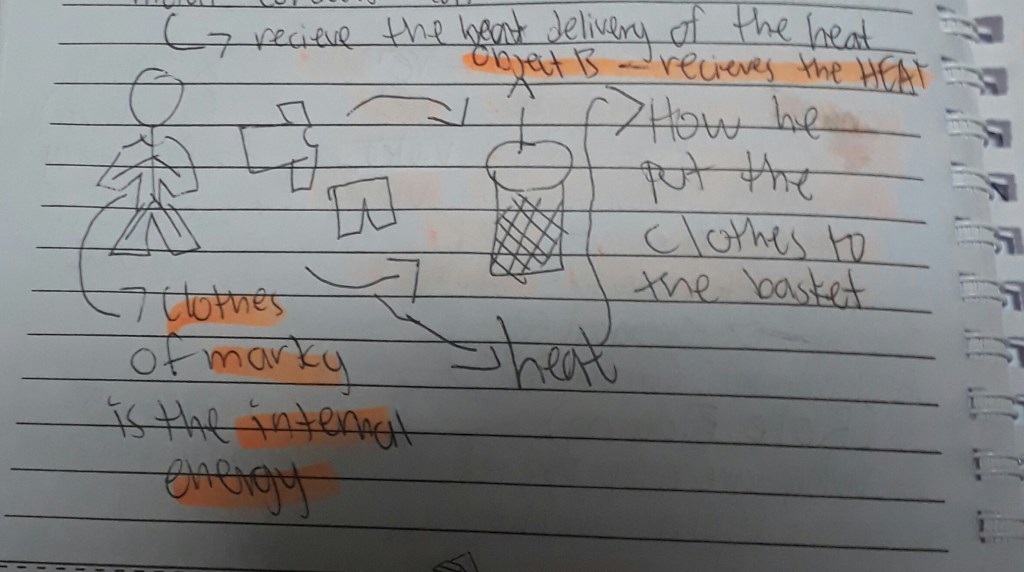
Application in life: 1 example of heat and internal energy is if I am wearing a clothes, those are the internal energy, and if I take it off, then put it in the laundry, therefore I am applying heat. This is because the laundry basket receives the heat, then how I put the clothes to the laundry basket, it also have heat.
 brandonbl0gz